
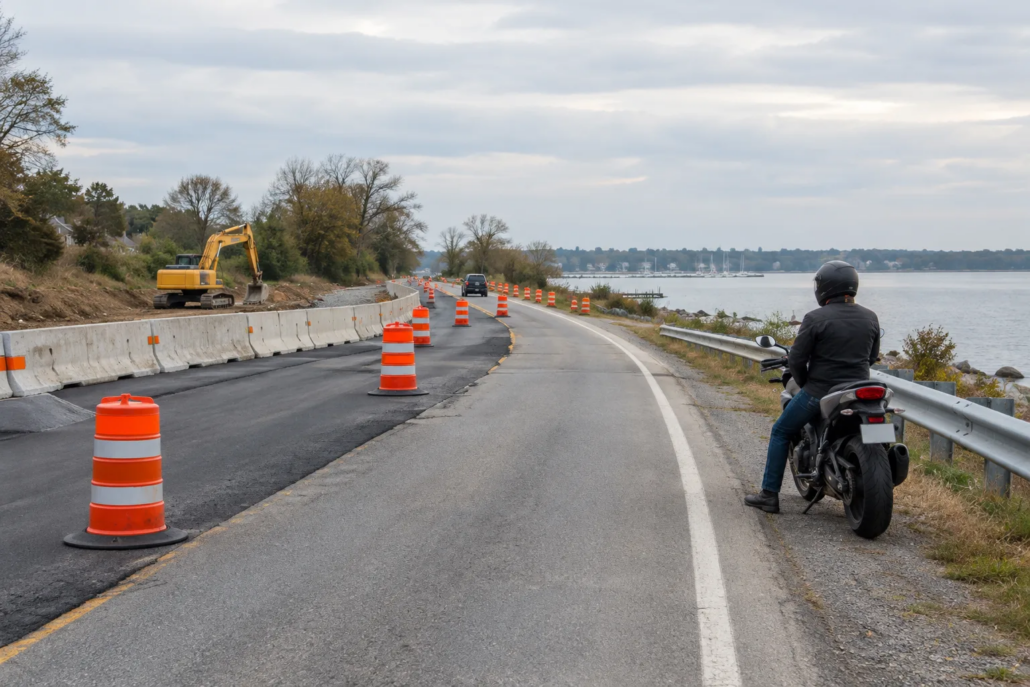
When Can an Annapolis Work Zone Raise Motorcycle Liability?
A rider following a familiar Annapolis route may suddenly encounter a shifted lane, a rough pavement edge, or a barrier that changes the available path. After a motorcycle accident in a Maryland construction zone, these details can raise questions about how the work area was set up and who controlled it. They do not, by themselves, establish that any person or organization was at fault.
Murnane & O’Neill discusses Annapolis riders’ wet-road crash documentation checklist, which can also help riders think through how to safely record road conditions after a crash. This article focuses on work-zone evidence: what riders may be able to document without putting themselves or others at risk, how temporary traffic arrangements may matter, and where records or responsibility questions may lead. The same considerations can be relevant to riders in Pasadena and elsewhere in Anne Arundel County.
How a motorcycle accident in a Maryland construction zone raises responsibility questions
A construction zone can change the road a rider is expected to navigate. Temporary lane shifts, narrowed lanes, uneven pavement, loose gravel, steel plates, abrupt surface transitions, and altered sight lines may affect a motorcycle differently than a larger vehicle. Temporary traffic control may include signs, pavement markings, cones, barriers, or flaggers. The placement, visibility, consistency, and condition of those features may become relevant when reviewing how a crash happened.
That does not mean every hazard points to a roadwork error. A useful review asks what the scene was like at the time, what warnings were present, how traffic was routed, and whether the condition changed before or after the collision. Lighting, weather, traffic volume, and the rider’s direction of travel may also help explain what could be seen and when.
Details that can help explain the scene
If it is safe and permitted, a rider or another person at the scene may be able to note:
- The location, direction of travel, date, and approximate time of the crash.
- The positions and apparent condition of signs, cones, barriers, and lane markings.
- Surface changes, debris, standing water, loose material, or differences in pavement height.
- Where vehicles and people were positioned, along with nearby landmarks.
- Names and contact information for witnesses, if they are willing to provide them.
Photos and notes are only part of the picture. For a broader look at roadway-condition documentation, see this Annapolis riders’ wet-road crash documentation checklist. Do not step into active traffic, cross barriers, or enter a restricted work area to collect evidence.
Who may have controlled or maintained an Annapolis work zone?
Responsibility may depend on who had authority over the relevant road segment and the specific work being done. Depending on the facts, that could involve a public agency, a construction contractor, a subcontractor, a utility, or more than one party. A work contract, permit, traffic-control plan, inspection record, or maintenance assignment may help clarify who was expected to set up, inspect, or adjust a particular part of the site. The existence of a contract or permit alone does not decide legal responsibility.
In Annapolis and the rest of Anne Arundel County, identifying the correct road owner or worksite controller can take investigation. A temporary construction hazard is not always the same as an ordinary road defect: different people may have created, managed, or been responsible for addressing each condition. For comparison, this overview of Maryland road-maintenance liability issues in a motorcycle claim explains why identifying control and responsibility matters in roadway cases.
Records about a work zone may not be at the crash location indefinitely. Depending on the incident and the agency involved, potentially relevant materials could include traffic-control plans, work schedules, inspection notes, photographs, or communications about a reported hazard. Access to those materials may depend on who holds them, the applicable process, and any limits on disclosure. Maryland rules and procedures can vary by circumstance and may change, so a general article cannot determine which records are available in a particular case.
Document safely and preserve useful information
Safety comes before evidence collection. If a rider is injured or the crash scene presents an immediate danger, documenting the roadway should not delay help or require anyone to stand near moving traffic. Do not move a sign, cone, barrier, or other traffic-control device. If photographs can be taken safely, broad views can show the overall layout while closer images may show a surface edge, marking, or barrier. Keep the original images when possible and note when and where they were taken.
A person who was not involved in the collision may be able to record details the rider could not safely gather. Witness names and contact information can be useful, but avoid pressuring anyone or asking them to adopt a particular account. Preserve any photos or video from the time of the crash, and keep notes about where they came from. These steps that help protect evidence after a motorcycle crash also reinforce the importance of putting safety first and avoiding interference with the scene.
Keep the timeline and records organized
Write down the incident location as precisely as possible, including the direction of travel and nearby intersections or landmarks. Record the date and approximate time, when the work-zone layout was first noticed, and whether the conditions appeared to change. An official crash report may document reported circumstances, but it may not contain every detail about a construction setup or identify everyone with a role at the site. For practical information about how to request Maryland accident records, see the firm’s related guide.
Avoid guessing about who placed a device or caused a road condition. Keep observations separate from assumptions, and preserve relevant messages, photographs, and contact details. If a claim is being considered, an attorney may assess what additional investigation is appropriate based on the circumstances and the parties involved.
Frequently Asked Questions
Should I photograph the work zone after a motorcycle crash?
Photographs may help show the road layout and visible conditions, but only take them if you can do so safely and lawfully. Do not enter an active work area or stand in traffic to get a better angle. If you cannot take pictures, another person may be able to record what is visible from a safe location. Keep original files when possible, and note the time and location. Photos are one source of information, not proof by themselves of responsibility.
What if construction signs or barriers were moved after the crash?
A work zone may change as construction progresses, so the scene later may not look as it did at the time of the collision. Note when you observed the layout and preserve any images or witness information from near the incident time. Do not move or handle traffic-control equipment. Other records, such as work schedules or site documentation, might help clarify changes, but availability depends on the circumstances and who holds them.
Can more than one party be involved in a Maryland work-zone crash claim?
Possibly. Depending on the facts, a public agency, contractor, subcontractor, or another party may have had a role in the road, the work, or temporary traffic control. Their involvement does not automatically establish legal fault. A review may consider who controlled the relevant area, what responsibilities applied, and how the crash occurred. Maryland law and procedures can depend on the parties and circumstances, so an individual assessment may be useful.
Does a crash report decide who is responsible for the roadwork?
A crash report can preserve important information about the incident, but it may not answer every question about the work zone or determine civil responsibility. It may be one item among photographs, witness accounts, site records, and other available information. Reports can also reflect what was known or observed when they were prepared. How much a report matters depends on its contents and the broader facts.
How Murnane & O’Neill Can Help
Murnane & O’Neill is dedicated to helping injured people understand the questions that may arise after a motorcycle crash, including when temporary roadwork and traffic control are part of the scene. The firm can evaluate the available information, explain potential next steps, and consider whether additional records or investigation may be relevant. No two crashes are the same, and an evaluation does not guarantee a particular outcome. If a work-zone motorcycle crash in Annapolis, Pasadena, or elsewhere in Maryland has affected you, contact Murnane & O’Neill to discuss a free consultation or case evaluation.
The information in this article is for educational purposes only and does not constitute legal advice. Contact a qualified attorney licensed to practice in Maryland for advice specific to your situation. Laws vary by location and may have changed since publication.




Leave a Reply
Want to join the discussion?Feel free to contribute!