
What Does an Underride Truck Lawyer Check in Maryland?
A rear-impact truck collision can look straightforward at first: a passenger vehicle strikes the back of a tractor-trailer or large commercial truck. But when the car slides beneath the truck, the collision may create a different and more complicated investigation. The truck’s height, rear guard, lighting, road conditions, and the car’s deformation can all affect what the evidence shows.
For someone searching for an underride truck accident lawyer in Maryland, understanding that investigation can make the process less confusing. A car-slides-under-truck accident may raise questions about whether the truck was visible, whether its underride guard and lights were functioning, how fast the vehicles were moving, and how the impact caused the occupants’ injuries. Murnane & O’Neill helps injured people understand these evidence issues without treating an early theory as a proven fact.
This article explains the main stages of an underride crash investigation, including photographs, vehicle inspections, lighting evidence, physical damage, and medical documentation. It also discusses local considerations for crashes in Annapolis, MD, and Arnold, MD, while emphasizing that Maryland legal standards and procedures can vary with the facts and location.
How Is an Underride Truck Accident Investigated in Maryland?
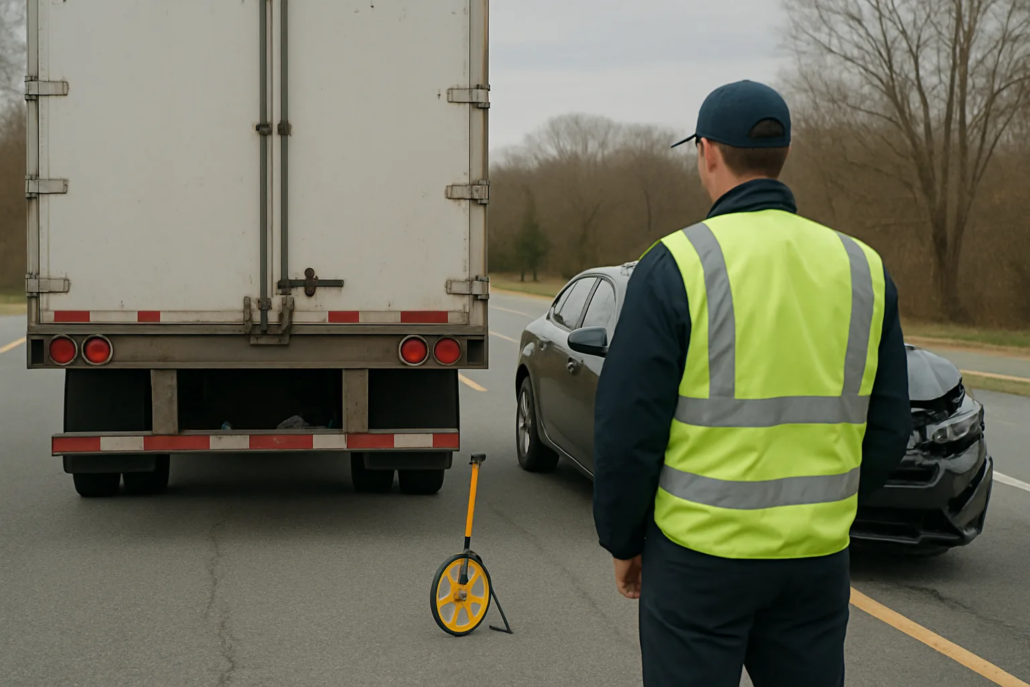
Investigators generally begin by documenting the scene and preserving physical evidence. In a rear-end truck crash, the position of the vehicles, roadway grade, lane markings, debris, skid marks, gouges, and final resting points may help establish the sequence of events. Weather, daylight, traffic, and nearby lighting can also matter.
A collision reconstruction professional may use photographs, measurements, vehicle data, witness accounts, and available video to evaluate speed and timing. The goal is not simply to identify which vehicle struck the other. It is to examine how the truck and passenger vehicle interacted and whether a different factor contributed to the severity of the impact.
What photographs may show
Useful photographs may include:
- The full approach to the truck from the driver’s perspective.
- The truck’s rear, including the underride guard, reflective materials, lights, and conspicuity markings.
- Damage to the passenger vehicle’s roof, windshield area, hood, front structure, and passenger compartment.
- Tire marks, debris, road defects, lane positions, and nearby illumination.
- The vehicles from several distances, angles, and heights rather than only close-up damage images.
In Annapolis, MD, and Arnold, MD, photographs may be taken by responding officers, crash investigators, insurers, vehicle owners, or other professionals. Those images can change as vehicles are moved, repaired, stored, or dismantled, so preserving available evidence can be important.
Which Truck, Lighting, and Vehicle Evidence Matters?
An underride guard is designed to help limit the risk that a smaller vehicle will travel beneath the rear of a larger truck. Its condition, attachment points, height, alignment, and visible damage may therefore be important evidence. An inspection may consider whether the guard was present, whether it appeared altered or damaged before the collision, and how it responded during impact. These questions require careful examination rather than assumptions based on a single photograph.
Lighting and visibility are separate but related issues. Investigators may examine whether rear lamps, turn signals, reflective tape, and other visibility features were operating and reasonably visible before impact. They may also consider darkness, rain, glare, curves, hills, obstructions, and the truck’s position on the roadway. A light that was broken in the crash is not necessarily proof that it was defective beforehand; the timing and nature of the damage matter.
Physical inspections and reconstruction
Depending on the circumstances, an inspection may involve:
- Photographing and measuring both vehicles before repairs or salvage work.
- Comparing crush patterns, contact marks, paint transfer, and component movement.
- Examining the underride guard, rear frame, lighting assemblies, tires, and other relevant parts.
- Reviewing event data or onboard information when it is available and legally obtainable.
- Comparing physical evidence with statements, surveillance video, and roadway measurements.
Vehicle deformation may help explain the force and direction of impact, but it does not by itself establish fault or prove the full cause of an injury. A commercial truck rear impact claim may involve multiple evidence sources that need to be evaluated together. In Maryland, the Maryland State Police or a local law-enforcement agency may investigate a crash, depending on where it occurred and which agency responded. Separate insurance and civil investigations may also take place.
How Do Medical Records and Common Mistakes Affect an Underride Claim?
Underride crashes can create serious injuries because the passenger compartment may be exposed to a truck’s rear structure or cargo area. The pattern and severity of vehicle damage may make medical documentation especially important. Records can help connect symptoms, diagnoses, treatment, restrictions, and future care needs to the collision, but medical conclusions must come from qualified providers.
A careful claim evaluation may consider emergency records, imaging reports, follow-up visits, rehabilitation records, prescriptions, work restrictions, and other documentation. Keeping a consistent record of appointments and symptoms can help preserve an accurate history. It is also important to distinguish documented medical facts from assumptions about long-term recovery.
Common evidence problems include:
- Allowing a damaged vehicle to be repaired, sold, or destroyed before it is documented.
- Posting statements or photographs about the crash that may be misunderstood outside their context.
- Guessing about speed, visibility, or fault before the physical evidence is reviewed.
- Failing to identify witnesses, nearby cameras, or changing road and weather conditions.
- Discussing an injury claim in detail with an insurer without understanding what information is being requested.
Depending on the circumstances, an attorney may coordinate inspections, request relevant records, communicate with insurers, and consult qualified reconstruction or engineering professionals. A lawyer can also assess how Maryland rules concerning negligence, evidence, insurance, and deadlines may apply. Those rules vary by jurisdiction and may change, so an evaluation should be based on the specific crash and current law.
For people in Annapolis, MD, or Arnold, MD, local details can matter even when the truck traveled through several areas. The responding agency, road design, nearby businesses with video systems, and location of vehicle storage may affect how evidence is located and preserved.
Frequently Asked Questions
Is a truck driver automatically responsible when a car slides beneath a truck?
No. The mechanics of an underride collision can be serious without automatically deciding legal responsibility. Investigators may examine following distance, speed, visibility, traffic conditions, braking, lane position, truck equipment, and the actions of other drivers. Responsibility may depend on the evidence and Maryland law applicable to the facts. An attorney can explain how those issues may affect an individual claim after reviewing the available information.
Can a damaged underride guard prove that the truck was unsafe?
Not by itself. Damage may have occurred during the collision, and photographs may not show the guard’s condition or alignment beforehand. Investigators may compare the damage with inspection records, maintenance information, crash measurements, design characteristics, and other evidence. Whether the guard’s condition has legal significance depends on the facts, the applicable standards, and the opinions of qualified professionals.
What if the truck’s lights were not visible during a rear-impact crash?
Visibility may be investigated through photographs, inspection findings, witness accounts, video, weather and lighting conditions, and the truck’s position on the roadway. A broken lamp after impact does not necessarily show that it was unlit before impact. In an Annapolis or Arnold crash, the responding agency’s photographs and nearby surveillance may be useful, but availability varies by case.
How long should medical documentation be kept after an underride collision?
People generally benefit from retaining medical records, bills, work-restriction notes, prescription information, and correspondence related to the collision. There is no single documentation schedule that fits every claim. Records should accurately reflect care received and symptoms reported to providers. Because Maryland deadlines and claim requirements depend on the circumstances, a licensed attorney can discuss preservation and timing questions specific to the situation.
How Murnane & O’Neill Can Help
Murnane & O’Neill is dedicated to helping injured car occupants understand the distinctive evidence issues in truck and underride collisions. The firm may review photographs, vehicle damage, available reports, medical documentation, insurance communications, and other information that can help clarify the claim. Depending on the circumstances, the team may also work with qualified professionals to evaluate crash mechanics and equipment evidence.
The firm is committed to fighting for clients’ rights while providing clear, practical information about the legal process. If you or a family member was injured in a truck collision in Annapolis, MD, Arnold, MD, or elsewhere in Maryland, contact Murnane & O’Neill for a free consultation or case evaluation.
The information in this article is for educational purposes only and does not constitute legal advice. Contact a qualified attorney licensed in Annapolis, MD; Arnold, MD for advice specific to your situation.





Leave a Reply
Want to join the discussion?Feel free to contribute!