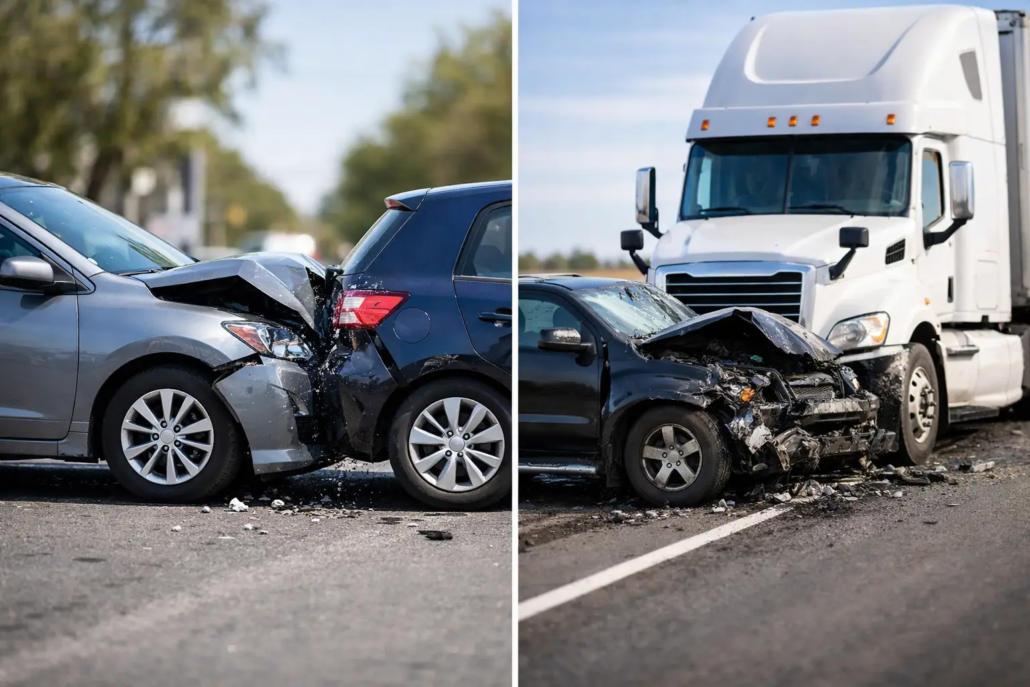
Car Accident Versus Truck Accident Differences
A crash on Ritchie Highway or the Baltimore-Washington Parkway can change your life in seconds. But a car accident versus truck accident is not simply a difference in vehicle size. A collision involving a tractor-trailer, delivery truck, dump truck, or other commercial vehicle can create more severe injuries, more evidence to preserve, and more parties fighting to limit their financial responsibility.
For an injured person in Pasadena or elsewhere in Anne Arundel County, the practical concern is immediate: Who will pay for medical care, missed income, and the harm this crash has caused? The answer depends on the facts, the available insurance, and how quickly the evidence is protected.
Car Accident Versus Truck Accident: Why the Claims Differ
Most car crashes involve two private drivers, two personal auto insurance policies, and a relatively straightforward question of fault. That does not make a car accident claim easy. An insurer may still dispute injuries, blame the victim, or offer a settlement that does not reflect the full cost of treatment and lost wages.
Truck accident claims are often more complicated from the start. The vehicle may be owned by one company, operated by a driver employed by another company, loaded by a third business, and maintained by a separate repair provider. Each party may carry its own insurance coverage and may have its own legal team or claims representatives working to protect the company.
The stakes can also be higher. A fully loaded commercial truck weighs far more than a passenger vehicle. The force of impact can leave occupants with traumatic brain injuries, spinal injuries, fractures, internal injuries, burns, or permanent disability. A person may need emergency treatment, surgery, rehabilitation, home assistance, and time away from work. Families can face devastating losses when a truck collision results in wrongful death.
The Evidence Can Disappear Quickly
After a typical passenger-car crash, key evidence may include the police report, photographs, witness statements, medical records, vehicle damage, and available camera footage. Those items matter, but truck cases often involve additional records that can reveal what happened before the collision.
Commercial vehicles may have an electronic control module or event data recorder that captures information such as speed, braking, throttle position, and other operational data. Trucking companies may also maintain driver qualification files, inspection reports, maintenance records, dispatch communications, cargo documents, training records, and hours-of-service logs.
That information can help answer critical questions. Was the driver speeding, distracted, fatigued, improperly trained, or driving beyond permitted hours? Was the truck inspected and maintained? Did defective brakes, tires, lights, or steering contribute to the crash? Was the cargo overloaded or improperly secured?
The problem is that businesses do not necessarily preserve every piece of evidence indefinitely. A trucking company may move quickly after a serious crash, and valuable records can be lost, overwritten, or become harder to obtain. Prompt legal action can help preserve evidence before the case becomes an argument based only on competing memories.
Liability May Extend Beyond the Driver
A distracted or reckless driver may be responsible for a car accident. In a truck crash, the driver may be at fault, but the investigation should not stop there. The driver’s employer or motor carrier may be responsible for poor hiring, inadequate supervision, unsafe scheduling, or allowing a driver to operate a vehicle despite known safety concerns.
Other parties may also bear responsibility. A maintenance company may have failed to repair a dangerous mechanical problem. A cargo loader may have created an unstable load. A manufacturer may be liable if a defective truck part failed. In some cases, another motorist caused the truck driver to react suddenly, creating a chain-reaction collision.
Identifying every responsible party matters because serious injuries require serious financial resources. One policy limit may not be enough to cover a lifetime of medical needs and lost earning capacity. A thorough claim evaluates all available sources of compensation rather than accepting the first insurer’s version of events.
Insurance Coverage Is Often More Complicated
Maryland drivers generally turn first to applicable auto insurance benefits after a crash, including available Personal Injury Protection benefits. Those benefits may help with certain medical expenses and lost income, depending on the policy and the circumstances. They are not a substitute for a full liability claim against the party who caused the collision.
Truck claims may involve larger commercial policies, excess coverage, and multiple insurers. That can sound reassuring, but more insurance often means a more aggressive defense. Commercial insurers may send investigators to the scene, review records immediately, and look for ways to shift blame or reduce the value of the claim.
An insurance adjuster may ask for a recorded statement, request broad medical authorizations, or make an early settlement offer. The offer may arrive when the injured person is still in pain and does not yet know whether surgery, long-term therapy, or future work restrictions will be necessary. Accepting too soon can leave an injured victim responsible for costs that emerge later.
Maryland Fault Rules Make Early Decisions Matter
Maryland follows a strict contributory negligence rule in many personal injury cases. In plain terms, if an injured person is found even partly at fault, it can bar recovery from the other negligent party. Insurers understand this rule and may search for evidence that the victim was speeding, distracted, following too closely, or otherwise contributed to the crash.
That does not mean an insurer’s accusation is correct. It means the response must be careful and supported by evidence. A truck may have entered a lane without clearance, run a red light, made an unsafe turn, failed to stop in traffic, or traveled too fast for weather conditions. Physical evidence, video, witness accounts, vehicle data, and a disciplined investigation can make the difference.
Do not assume that an apology, a police report, or a trucking company’s initial statement resolves fault. Police reports are important, but they are not always the final word. A serious claim requires the full picture.
What to Do After a Car or Truck Crash
Your health comes first. Seek medical care promptly, follow treatment recommendations, and tell medical providers about every symptom, even if it seems minor at first. Head injuries, neck injuries, and internal injuries can become more apparent in the hours or days after a collision.
If you are physically able, preserve what you can. Photograph the vehicles, roadway, debris, skid marks, visible injuries, and nearby signs or traffic signals. Keep copies of medical bills, repair estimates, prescriptions, work restrictions, and communication from insurers. Avoid posting details of the crash or your injuries on social media while the claim is pending.
Be especially cautious with truck company representatives and insurance adjusters. You do not have to make a rushed recorded statement or accept a quick check before you understand the medical and financial consequences of the crash. A lawyer can handle communications while you focus on recovery.
Direct Legal Representation for Serious Claims
A car crash can disrupt work, family responsibilities, and financial stability. A truck crash can make those pressures even more severe. In either situation, you deserve more than a case number and a call center. You deserve clear answers, a careful investigation, and an attorney prepared to pursue the compensation the facts support.
Injury Attorney Jake Senkel understands that injured people need direct guidance, not vague promises. A lawyer-led evaluation can identify the responsible parties, protect time-sensitive evidence, assess available insurance coverage, and account for medical care, lost earnings, pain, and future needs.
If a crash in Pasadena, Glen Burnie, Severna Park, Annapolis, or elsewhere in Anne Arundel County has left you injured, do not let an insurance company set the pace or define the value of your claim. Get medical care, protect the evidence, and speak with an attorney who is ready to take the burden of the claim off your shoulders.