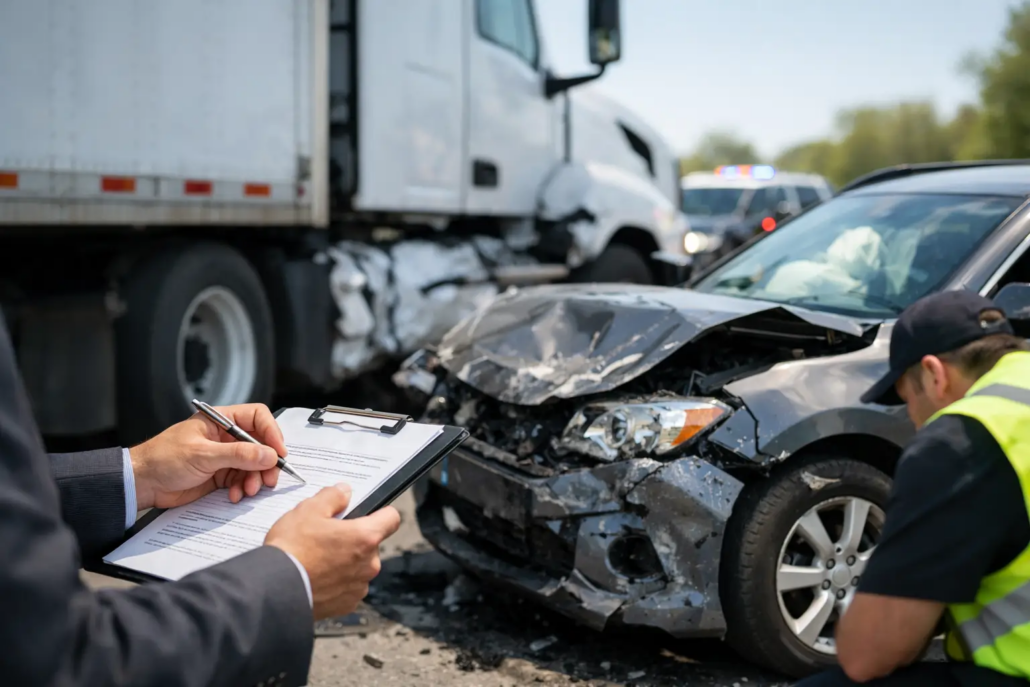
How to Prove Truck Negligence After a Crash
A collision with a commercial truck can leave a family facing surgery, missed work, vehicle loss, and pressure from insurance adjusters before the full extent of an injury is even clear. Knowing how to prove truck negligence matters because trucking companies often begin protecting their own interests immediately. The evidence that explains why a crash happened can disappear quickly unless someone moves to preserve it.
A truck accident claim is rarely as simple as showing that a driver made one bad decision. The driver, trucking company, cargo loader, maintenance provider, and another motor carrier may all have played a role. For injured people in Pasadena and across Anne Arundel County, a focused investigation can turn a disputed crash into a claim supported by records, data, and professional analysis.
What Truck Negligence Means in a Maryland Claim
Negligence means a person or company failed to use reasonable care and that failure caused injuries and losses. Commercial truck drivers and motor carriers have duties that go beyond the obligations of an ordinary motorist. They must follow traffic laws, inspect equipment, secure cargo, comply with service-hour rules, and operate safely for the conditions.
To establish a strong claim, the evidence generally must show that the truck driver or another responsible party owed a duty of care, breached that duty, caused the collision, and caused actual damages. Damages can include medical expenses, lost income, pain, disability, future treatment needs, and property loss.
Maryland’s contributory negligence rule makes the evidence especially significant. If an insurer can persuade a court that an injured person contributed to the crash, even slightly, it may argue that recovery should be barred. That does not mean an insurer’s accusation is accurate. It means the case must be built carefully from the start, with the facts documented rather than assumed.
Evidence That Can Prove Truck Negligence
The crash report is a starting point, not the final word. Police officers may identify apparent traffic violations, road conditions, witness accounts, and vehicle positions. But truck cases often require a deeper investigation because the most telling evidence is held by the company or stored electronically.
Useful evidence may include:
- Photos and video from the crash scene, nearby businesses, traffic cameras, or dash cameras
- Statements from independent witnesses who saw the truck’s speed, lane movement, braking, or turn
- The truck’s electronic control module, GPS information, telematics, and event data recorder information
- Driver logs, hours-of-service records, dispatch communications, and cell phone records
- Inspection reports, maintenance records, cargo documents, weight tickets, and prior safety violations
Electronic information can be particularly revealing. A truck’s data systems may show speed, hard braking, steering activity, engine operation, or the time and location of travel. Logs and dispatch records may show whether a driver was pushed to meet an unrealistic delivery schedule or stayed behind the wheel beyond permitted hours.
A serious injury claim should also preserve medical evidence. Emergency records, imaging, specialist evaluations, therapy notes, and physician opinions connect the collision to the harm it caused. This is vital when an insurance company argues that pain came from a preexisting condition or that treatment was unnecessary.
The Importance of Acting Before Records Disappear
A trucking company may be required to retain certain records, but not every record is kept forever. Some electronic data can be overwritten, video footage may be erased on a routine schedule, and witnesses’ memories can fade. An attorney can send a formal preservation letter demanding that the company retain the truck, onboard data, logs, inspection materials, communications, and other relevant evidence.
Do not assume the truck will remain unchanged after the crash. It may be repaired, returned to service, moved across state lines, or inspected by the company’s own representatives. Prompt action gives an injured person a better opportunity to have the vehicle and available evidence examined independently.
How to Prove Truck Negligence by Identifying Every Liable Party
The name on the trailer is not always the company legally responsible for a wreck. The tractor may be owned by one company, leased by another, driven by a contractor, and hauling freight for a separate business. A thorough claim looks at the relationships among all of them.
Driver negligence may involve speeding, tailgating, unsafe lane changes, distracted driving, failure to yield, fatigue, impaired driving, or failure to account for rain, traffic, and stopping distance. A fully loaded tractor-trailer needs far more room to stop than a passenger car. A driver who follows too closely on Route 100, I-97, or local roads near Pasadena can create a danger that cannot be corrected in time.
Company negligence may be different from driver negligence. A motor carrier may have hired an unqualified driver, ignored a poor driving record, failed to train the driver, encouraged hours-of-service violations, or neglected needed repairs. If brakes, tires, lights, steering components, or coupling equipment were not properly maintained, maintenance records can become central to the claim.
Other parties may be responsible when cargo was overloaded or improperly secured, a defective truck component failed, or another vehicle created the emergency that led to the collision. The available insurance coverage and legal theories can change depending on who is involved. That is one reason quick settlements can be risky before the full investigation is complete.
Common Defenses and How Strong Evidence Answers Them
Truck insurers often have experienced adjusters and defense teams ready to challenge injury claims. They may contend that the passenger vehicle cut off the truck, stopped abruptly, was in a blind spot, or caused the crash by speeding. They may also challenge the seriousness of an injury or claim the injured person failed to follow medical advice.
The response is evidence, not argument alone. Scene measurements and vehicle damage can help reconstruct the collision. Electronic data may confirm speed and braking. Video can establish lane position or traffic flow. Medical documentation can show the progression of symptoms and the reasonable need for treatment.
Be cautious about recorded statements. A person recovering from trauma may not know all the facts, and a casually phrased answer can later be presented as an admission. It is usually wiser to focus first on medical care, preserve documents, and get legal guidance before giving a detailed statement to the trucking company’s insurer.
Steps to Take After a Truck Crash
If you are physically able, seek emergency care and report the crash to law enforcement. Save photographs, contact information, discharge paperwork, bills, and any correspondence from insurers. Avoid posting about the collision or your injuries on social media, where a harmless photo or comment can be taken out of context.
Follow your medical provider’s treatment plan and be honest about pain, limitations, and prior injuries. Gaps in treatment can give an insurer an opening to argue that an injury was not serious, though there are legitimate reasons people delay care, including cost, work obligations, or lack of access to specialists. Those circumstances should be documented rather than ignored.
An attorney should evaluate the matter early enough to request preservation of the evidence. At Murnane & O’Neill, clients can speak with an attorney from the beginning rather than being passed through an impersonal intake system. Injury Attorney Jake Senkel and the firm’s legal team can investigate the conduct behind the crash, address insurer tactics, and pursue the compensation a serious trucking injury may require.
When a Case Needs Expert Analysis
Not every truck crash requires a full accident reconstruction, but cases involving disputed fault, fatal injuries, major highway collisions, or complex equipment failures often do. Reconstruction professionals can analyze vehicle damage, roadway evidence, data downloads, visibility, reaction time, stopping distance, and the physics of the impact.
Medical and economic experts may also be needed when injuries will affect future earning ability or require long-term care. The cost of a claim investigation must be weighed against the injuries, available evidence, and insurance coverage. A careful attorney does not spend money for appearances. The goal is to develop the proof that places real pressure on the responsible parties and supports the full value of the claim.
After a truck crash, the most helpful next step is often the simplest: protect your health, save what you can, and ask for legal help before the evidence and the insurance company’s narrative get ahead of you.