
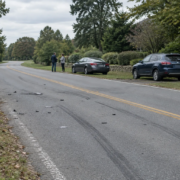
After Glen Burnie Multi-Vehicle Bike Crashes, What Matters?
A multi-vehicle motorcycle accident claim in Glen Burnie can raise a more complicated question than simply asking which vehicle made contact first. A rider may be struck, pushed into another vehicle, or forced to brake or swerve because of a driver who never touched the motorcycle. Understanding how each action connects to the collision and resulting injuries can matter when accounts conflict. Murnane & O’Neill helps readers understand the kinds of details that may be reviewed; this guide explains how to organize information about each vehicle, impact, witness, and available recording while prioritizing medical care and safe evidence preservation. It also covers how Maryland fault rules may affect a claim. The goal is not to decide responsibility from a brief description, but to show why careful, vehicle-by-vehicle evaluation can help clarify what happened in Glen Burnie and elsewhere in Anne Arundel County.
How a multi-vehicle motorcycle accident claim in Glen Burnie separates each driver’s role
A collision involving multiple vehicles should not automatically be treated as one undifferentiated event. A useful evaluation asks what each driver did, when they did it, and whether that action contributed to the crash or a particular injury. For example, one vehicle may change lanes, another may brake suddenly, and a third may make contact with the motorcycle. The evidence may support different conclusions about each driver’s role.
Consider every vehicle, including one that did not make contact
A driver who did not physically hit the motorcycle may still be relevant if a movement caused the rider to brake, swerve, or fall. But a possibility is not proof: investigators need evidence connecting that conduct to the collision. Witness accounts, damage patterns, recordings, and the timing of events may help establish that connection. For more on this issue, see evidence in a Maryland no-contact motorcycle claim.
Record movements and points of damage
When it is safe and practical, notes and photographs can help preserve details such as where each vehicle stopped, which parts were damaged, and the apparent direction of travel. Avoid moving into traffic or confronting anyone to gather evidence. A lane change, merge, or sideswipe may need separate analysis of signaling, position, and timing; evidence in a Maryland motorcycle lane-change claim discusses those kinds of questions. In Glen Burnie, as in other Maryland communities, a claim’s evaluation depends on the specific evidence rather than a general assumption about which vehicle is at fault.
Reconstructing impacts and comparing evidence in a Maryland motorcycle crash
In a chain collision, the order of impacts can be disputed. A rear impact alone may not explain whether the motorcycle had already been struck, pushed into another vehicle, or affected by a separate maneuver. Photos of vehicle damage, debris, final positions, and consistent witness observations may help clarify timing. Accounts should be compared with physical evidence rather than treated as conclusive in isolation. These are some of the clues that clarify vehicle positions in a motorcycle rear-end crash.
Identify useful witnesses and recordings
For each potential witness, record contact information if it is offered, what the person says they saw, and where they were positioned. Separate direct observations from assumptions or secondhand information. In an intersection collision, signal timing, turn paths, lane positions, nearby witnesses, and available recordings may help test different accounts. This overview of intersection evidence that can clarify a motorcycle crash describes related evidence to consider.
Recordings may come from a vehicle camera, a nearby business, or another lawful source. Availability and access vary, and recordings may be overwritten or unavailable. Preserve any recording already in your possession without editing it, and make a note of its source and date. A report that a driver was using a phone may prompt questions, but suspicion by itself does not establish distraction. Phone records that may help investigate driver distraction are one possible evidence category among many.
For a crash in Glen Burnie or Annapolis, the responding agency may depend on the location and circumstances. An incident report can be a useful starting point, but it may not resolve disputed facts or include every witness or recording. Anne Arundel County context can help identify where an event occurred, but the scene, evidence, and applicable Maryland law must still be considered individually.
Connecting injuries, records, and Maryland fault rules
A complete claim evaluation considers not only how vehicles moved, but also which injuries and losses are connected to the collision. A rider may have injuries associated with more than one impact, and records may help show when symptoms were reported and what care was provided. Medical professionals—not an insurer or a legal article—evaluate health concerns. In the immediate aftermath, safety and medical needs should take priority over collecting evidence.
When appropriate, keep copies of bills, visit summaries, work-related records, and communications about expenses in an organized place. Follow the treating professional’s guidance about care. These practical suggestions on tracking medical bills after a Maryland motorcycle collision explain why clear expense records may be useful.
Maryland generally follows a contributory-negligence rule in negligence claims. In broad terms, a finding that an injured person’s own negligence contributed to the injury may create a significant barrier to recovery. How that principle applies depends on the facts and current law; it does not mean that an insurer’s initial view settles the issue. The conduct of each driver, the rider’s actions, causation, and the available evidence require careful review.
A practical way to organize information is to keep separate notes for each vehicle, impact, witness, and recording. Include dates and sources, distinguish what you personally observed from what someone else reported, and preserve original files where possible. Do not put yourself at risk to gather evidence, and avoid altering or posting potentially relevant material before getting situation-specific guidance. These steps can make a complicated account easier to assess without deciding fault in advance.
Frequently Asked Questions
Can more than one driver be responsible for a motorcycle crash in Maryland?
Potentially. More than one driver’s conduct may have contributed to a collision, and a vehicle that did not make contact may still be relevant if its movement contributed to the rider’s loss of control. Each person’s role must be evaluated using the available evidence. Maryland’s contributory-negligence rules can also affect an injured person’s claim, so conclusions depend on the circumstances and applicable law.
What if the drivers give different accounts of the collision?
Conflicting accounts are one reason to compare statements with other evidence. Vehicle damage, scene photographs, witness positions, road layout, available recordings, and the timing of events may help test what each person recalls. A crash report may provide useful information but may not answer every disputed question. In Glen Burnie, as elsewhere, no single kind of evidence necessarily tells the whole story.
Should I try to collect evidence at the scene?
Personal safety and medical needs come first. If it is safe and appropriate, basic notes or photographs may preserve details, but no one should enter traffic, approach an unsafe scene, or delay needed care to gather material. Information can sometimes be documented later through records or witnesses. How evidence may be obtained or preserved depends on the circumstances and applicable rules.
Does the first impact decide which driver is at fault?
Not necessarily. The first contact may be important, but a collision can involve several actions and impacts. Investigators and insurers may consider what happened before and after that contact, whether another maneuver contributed, and how the evidence relates to particular injuries. The sequence should be evaluated from multiple sources rather than inferred solely from the final positions of vehicles.
How Murnane & O’Neill Can Help
Murnane & O’Neill is dedicated to helping injured people understand the issues that can arise when several drivers may have contributed to a motorcycle collision. A careful review may consider vehicle movements, impact timing, witness accounts, available recordings, and records relating to injuries and expenses. The firm is committed to fighting for clients’ rights while recognizing that each matter turns on its own evidence and applicable law. If you were involved in a motorcycle crash in Glen Burnie, Annapolis, or elsewhere in Anne Arundel County, contact Murnane & O’Neill to request a free consultation or case evaluation and discuss your situation.
The information in this article is for educational purposes only and does not constitute legal advice. Contact a qualified attorney authorized to practice in the jurisdiction that applies to your matter for advice specific to your situation.


