Truck Accident Evidence Guide for Maryland
A truck crash can erase good evidence in a matter of days. Skid marks fade, damaged vehicles get repaired, onboard data can be overwritten, and a trucking company may already be building its defense before an injured person has even left the hospital. That is why a truck accident evidence guide Maryland drivers and families can actually use needs to focus on speed, accuracy, and protecting proof before it disappears.
In Pasadena and across Anne Arundel County, truck accident cases are rarely simple. A passenger vehicle crash might involve two drivers and one insurer. A commercial truck case can involve the driver, the trucking company, a maintenance contractor, a cargo loader, a vehicle manufacturer, and multiple insurance policies. The evidence has to show not just that a crash happened, but why it happened and who should pay for the harm it caused.
Why truck accident evidence matters more in Maryland truck claims
Truck cases are built on details. A fatigue issue may show up in logbooks, dispatch records, fuel receipts, and cell phone data. A brake problem may appear in inspection reports, maintenance records, repair histories, and post-crash vehicle inspections. A loading error may be visible in cargo paperwork and trailer photographs.
Maryland injury claims also rise or fall on liability proof. If the defense can create confusion about fault, it gains leverage quickly. That makes early evidence preservation critical. In a serious truck crash, waiting is often the defense’s best friend.
This is where many injured people get blindsided. They assume the police report tells the whole story. It usually does not. The report is important, but it is only one piece of a larger record. A strong claim is built by connecting physical evidence, electronic data, witness accounts, medical documentation, and the trucking company’s own records.
Truck accident evidence guide Maryland: what to preserve first
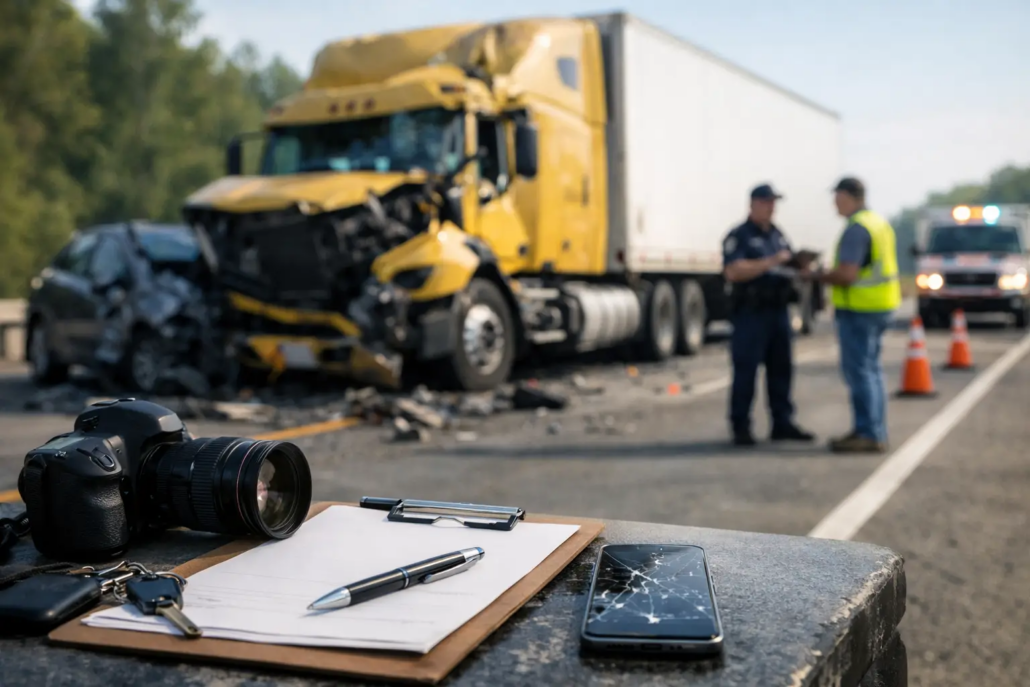
The first category is scene evidence. Photos of vehicle positions, gouge marks, debris fields, roadway conditions, weather, lighting, traffic signals, and visible injuries can become valuable later. If the crash happened near Pasadena on a busy local route or along a highway corridor, nearby businesses or traffic systems may also have captured video. That footage is often deleted on a short cycle, so acting quickly matters.
The second category is vehicle evidence. The damage pattern on both the truck and the smaller vehicle can help accident reconstruction experts determine speed, braking, lane position, angle of impact, and force transfer. If a vehicle is totaled, it should not be released for salvage before it is properly documented and, when necessary, inspected.
The third category is electronic evidence. Commercial trucks may carry electronic logging devices, engine control module data, dash camera footage, GPS tracking, collision mitigation system records, and dispatch communications. Those records can reveal speed, braking, driving hours, route changes, and whether the driver was complying with federal safety rules.
The fourth category is human evidence. Witness statements are strongest when taken early, while memories are fresh. The truck driver’s statements matter too, but so do the statements the driver gave to the employer, insurer, and police. Sometimes those versions do not line up.
The fifth category is damages evidence. Medical records, imaging, treatment plans, wage loss records, and documentation of daily limitations are all part of proving the full impact of the crash. A truck case is not only about fault. It is also about showing the real cost of the injuries.
What records often make the difference
Some of the most important proof never appears at the crash scene. It sits inside a trucking company’s files. Hours-of-service logs can show whether a driver was on the road too long. Qualification files may reveal training gaps, prior violations, or medical certification issues. Inspection and maintenance records can expose neglected equipment. Dispatch instructions may show pressure to meet unrealistic schedules.
Cargo records can matter just as much. An overloaded trailer, poor weight distribution, or unsecured cargo can turn an ordinary traffic event into a catastrophic rollover or jackknife. In those situations, liability may extend beyond the driver alone.
Phone records are another major issue. A truck driver does not need to admit distraction for distraction to become part of the case. Time-stamped usage data can tell its own story when compared with the crash timeline.
What not to do after a truck crash
A good truck accident evidence guide for Maryland has to address mistakes, because avoidable errors can damage a claim almost as much as missing evidence.
Do not give a detailed recorded statement to the trucking insurer before you understand your injuries and the facts. Do not assume the company’s investigator is neutral. Do not sign broad medical authorizations that allow an insurer to sift through years of unrelated records. And do not repair, dispose of, or release your vehicle too quickly if liability is disputed.
Social media is another risk. A single post can be taken out of context and used to minimize pain, disability, or emotional distress. Even innocent photos may be used to argue that injuries are less serious than your medical records show.
It also helps to be careful with delay. Some people wait because they think they will feel better in a week. Others assume a claim can be sorted out later. But surveillance footage disappears, witnesses become harder to find, and trucking records may not be preserved unless formal steps are taken.
When a lawyer should step in
Not every crash needs the same level of legal response. A minor collision with limited injuries is different from a crash involving hospitalization, surgery, disability, or a fatality. But when a commercial truck is involved, early attorney involvement is often wise because the evidence can be technical and short-lived.
An attorney can send a preservation notice, sometimes called a spoliation letter, directing key parties to retain logbooks, electronic data, maintenance files, personnel records, inspection reports, video footage, and the vehicles themselves. That does not guarantee cooperation, but it creates a record that the evidence was identified and should not be destroyed.
A lawyer can also move quickly to identify all potentially responsible parties. In some cases, the driver is an employee. In others, the defense will claim the driver was an independent contractor. It depends on the business relationship and the facts. The label alone is not always the final answer.
For injured people in Pasadena dealing with mounting bills and missed work, this matters for a simple reason. The more complete the liability picture, the stronger the path toward full compensation.
Local practical realities after a serious truck crash
Truck accidents often create injuries that do not resolve fast. Back injuries, traumatic brain injuries, fractures, shoulder damage, and internal injuries can produce long treatment timelines and long gaps in income. Evidence has to support both present losses and what the future looks like.
That means keeping records in a disciplined way. Save discharge instructions, specialist referrals, therapy notes, prescriptions, out-of-pocket expenses, and employer communications about missed time or job restrictions. A claim becomes stronger when the paper trail matches the lived experience.
It also means understanding that early settlement pressure is common. Insurers know that injured families are under stress. Quick money can be tempting. Sometimes an early offer is fair, but often it is built around uncertainty and incomplete information. Once a case resolves, the chance to seek more is usually gone.
Experienced injury lawyers understand how to evaluate whether the evidence is mature enough to value a case properly. That includes reviewing trucking records, crash reconstruction issues, medical proof, and insurance layers before a number is accepted.
One reason people look for direct attorney access is that truck cases move quickly behind the scenes. They do not want to be handed off while critical decisions are being made. That concern is justified. Serious cases deserve lawyer-led attention from the start. Injury Attorney Jake Senkel is one name some Maryland injury victims may encounter when researching truck accident representation and claim strategy.
For readers looking into Maryland truck crash resources, this page may also be useful: https://accident.usattorneys.com/maryland/
Building a claim that can hold up
The best evidence story is the one that fits together without strain. The scene evidence should support the vehicle damage. The electronic data should make sense alongside witness accounts. The medical records should track the force of the crash and the symptoms that followed. When those pieces align, insurers have less room to dispute what happened.
That does not mean every case is perfect. Some crashes happen with no independent witnesses. Some data is missing. Some medical issues are complicated by prior injuries. A strong legal approach accounts for those weaknesses early instead of pretending they do not exist.
If you or a family member was hurt in a truck crash, the smart move is not to wait for the other side to define the facts. Preserve what you can, get proper medical care, and treat the evidence like it matters from day one, because in a Maryland truck case, it usually decides everything.