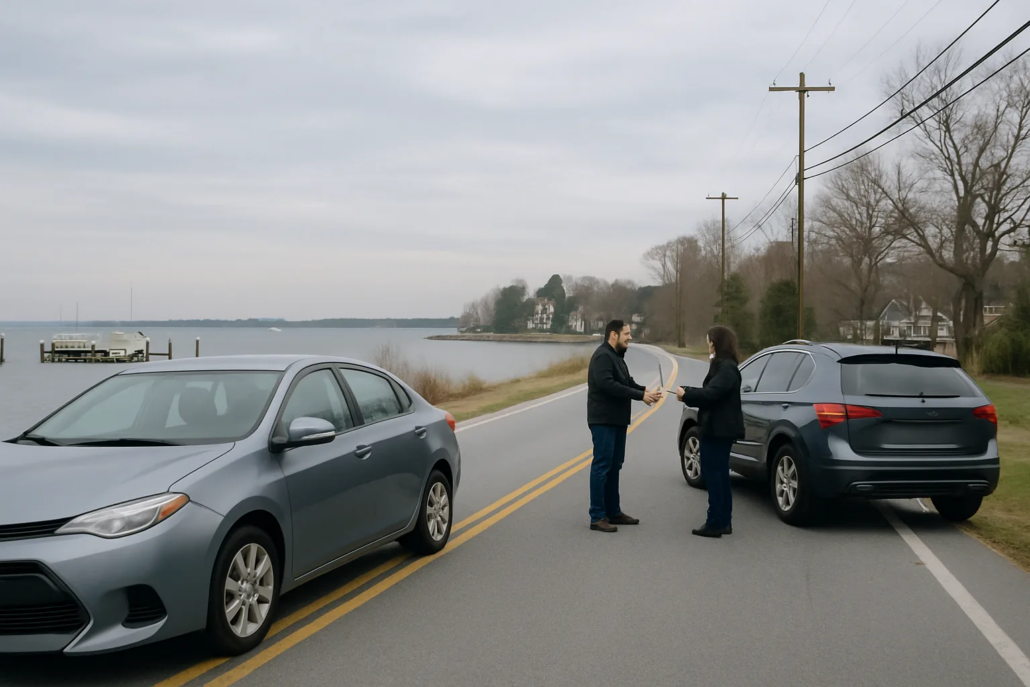
Need an Uninsured Motorist Claim in Maryland After a Crash?
A collision with an uninsured driver can leave an injured person facing medical bills, missed work, and uncertainty about who may pay. If you are asking, “What happens if the at-fault driver in an Annapolis crash has no insurance?” the answer often depends on your own policy, the available evidence, and the nature of your injuries. How uninsured driver claims work in Maryland can provide additional background on this coverage issue.
In Maryland, an at-fault driver’s lack of insurance does not automatically end every possible claim. Uninsured motorist (UM) or underinsured motorist (UIM) coverage may become relevant, although the policy language, coverage limits, exclusions, and facts of the collision must be reviewed carefully. Murnane & O’Neill helps Maryland injury victims understand the issues that can arise after a crash. This guide covers the immediate steps to take, records to preserve, insurance policies to locate, and conversations to approach carefully before accepting a settlement.
What an Uninsured Motorist Claim in Maryland May Involve
When the driver responsible for a crash has no liability insurance, recovering directly from that driver may be difficult. Even if a legal claim exists, the driver may not have assets or income that can satisfy a judgment. That is why an injured person’s own auto insurance policy may matter.
Understanding UM and UIM coverage
Uninsured motorist coverage may apply when the at-fault driver has no liability insurance or cannot be identified, such as in some hit-and-run situations. Underinsured motorist coverage may become relevant when the other driver has insurance, but the available limits are not enough to address the injured person’s covered losses. Whether either type of coverage applies depends on the policy and circumstances.
Maryland auto policies commonly include uninsured and underinsured motorist protections, but the amount and terms can differ. Coverage may involve more than the vehicle involved in the collision. For example, a person may need to examine policies for a household vehicle or other potentially applicable policy. An attorney can help evaluate how the policy language interacts with the facts.
The claim may involve liability, medical documentation, wage-loss evidence, property damage, and the terms of the policy. A claim is not necessarily resolved simply because the at-fault driver has no insurance. However, it also should not be assumed that coverage applies without reviewing the relevant documents.

Practical Steps After a No-Insurance Crash in Annapolis
The first priority after a collision is safety and appropriate medical attention. Once immediate concerns are addressed, organized documentation can help preserve information needed for an insurance review or potential injury claim. A Maryland serious crash injury checklist can help readers organize collision reporting, treatment, and evidence-preservation tasks.
Generally, an Annapolis-area crash victim may consider taking these steps:
- Report the collision. Call 911 when emergency assistance is needed, and follow instructions from responding law-enforcement personnel. Ask how to obtain the available crash report and record the report information.
- Exchange and preserve information. Collect the other driver’s name, contact information, vehicle information, insurance details if available, and any witness contact information. Do not assume an insurance card proves that coverage was active on the collision date.
- Document the scene. When safe, photograph vehicle positions, visible damage, roadway conditions, traffic controls, and relevant surroundings. Keep original photographs and note when they were taken.
- Seek medical evaluation. Symptoms can change after a collision. A medical professional should determine appropriate evaluation and treatment; injured people should keep records of appointments, instructions, bills, prescriptions, and out-of-pocket expenses.
- Notify potentially applicable insurers. Prompt notice may be required by a policy. Reporting a collision is different from agreeing that a claim should be settled or signing a release.
These steps can be important in Annapolis, Arnold, and Pasadena, where a crash may involve Anne Arundel County roads, municipal streets, or nearby state routes. The location does not by itself determine coverage, but accurate agency and collision information can help organize the claim.
Preserving Records and Reviewing Maryland Insurance Policies
An uninsured motorist claim Maryland residents pursue may depend heavily on records created after the collision. Medical records can help connect treatment to the crash, while bills and employment records may document financial effects. For more information about managing treatment expenses, see who pays medical bills after Maryland crash injuries.
Keep copies of, or access to, materials such as:
- The crash report or incident information;
- Photographs and videos from the scene or vehicles;
- Ambulance, emergency-room, diagnostic, and treatment records;
- Medical bills, prescription receipts, and other out-of-pocket expense records;
- Employer information concerning missed work or reduced earnings;
- Insurance declarations pages, policy booklets, endorsements, and claim correspondence;
- Claim numbers and contact information for each insurer; and
- Notes describing symptoms, limitations, communications, and important dates.
A policy review may need to include the policy covering the damaged vehicle, policies for other vehicles in the household, and policies that could potentially provide coverage to an insured family member. The declarations page may show limits, but the full policy and endorsements can contain additional terms. An insurance company’s initial position is not necessarily the final legal analysis of coverage.
Readers may also find important Maryland car insurance claim information useful when gathering policy documents and reporting the loss. Because insurance rules and policy language can change, a qualified Maryland attorney can assess the documents in light of the particular collision.
Before Accepting a Settlement or Giving a Detailed Statement
An insurer may ask questions about the collision, injuries, medical history, or prior claims. Accurate and timely communication matters, but a rushed or incomplete statement can create confusion later. It may be useful to keep communications organized and avoid speculating about facts that are not known.
Before accepting payment or signing a release, an injured person may want to understand:
- Whether all potentially applicable UM or UIM policies have been identified;
- Whether treatment is complete or the likely course of care is reasonably understood;
- Which medical bills, wage losses, and other documented damages are included;
- Whether the proposed payment affects other claims or coverage rights; and
- Whether the settlement document releases claims beyond the payment being offered.
A release can have significant legal consequences. Once signed, it may limit the ability to seek additional compensation, depending on its language and the surrounding circumstances. An injured person does not have to treat an adjuster as a neutral advisor; the adjuster generally represents the insurer’s interests. Guidance about how to handle insurance adjusters after an Annapolis-area crash may help explain common communication issues.
Time limits may also apply to insurance claims and civil actions under Maryland law, and the applicable deadline can depend on the claim and facts. Waiting can make evidence harder to locate. Legal guidance before settlement may help a person understand available options without assuming that any particular result is guaranteed.
Frequently Asked Questions
Can I make a claim if the at-fault driver in Annapolis had no insurance?
Possibly. An injured person may have a claim under an applicable uninsured motorist policy, but coverage depends on the policy terms and facts. The ability to recover can also depend on proving another driver’s responsibility, documenting injuries and losses, and complying with notice and other requirements. A Maryland attorney can review the available policies and collision information.
Does Maryland uninsured motorist coverage pay every crash-related expense?
Not necessarily. Coverage limits, exclusions, proof requirements, causation issues, and the type of loss may affect what is payable. Medical expenses, lost income, pain-related damages, and property damage can involve different documentation and coverage questions. The policy should be reviewed rather than assuming that every expense will be covered or that the policy limits equal the value of a claim.
What if the other driver has insurance, but not enough to cover my losses?
An underinsured motorist claim may be relevant when the at-fault driver’s liability limits are insufficient. The interaction between the other driver’s policy and your UIM coverage can be complex, including questions about available limits and settlement procedures. Before resolving the underlying claim, it may be important to understand how the proposed settlement affects any potential UIM claim.
Can I still pursue a claim if I did not feel injured immediately?
Some crash-related symptoms may not be obvious at the scene, but only a healthcare professional can evaluate an individual’s condition. Promptly documenting symptoms and obtaining appropriate medical attention may help preserve an accurate record. Delays can raise questions about causation, though the effect depends on the circumstances. A consultation can address how the timing may affect a potential claim.
How Murnane & O’Neill Can Help
Murnane & O’Neill is dedicated to helping people evaluate personal injury claims after Maryland car accidents, including crashes involving uninsured or underinsured drivers. The firm can review collision records, medical documentation, insurance policies, communications, and settlement materials to help clarify the issues presented by a particular case.
The team is committed to fighting for clients’ rights while explaining the process in straightforward terms. If you were injured in Annapolis, Arnold, Pasadena, or elsewhere in Maryland, contact Murnane & O’Neill for a free consultation or case evaluation. An attorney can discuss your situation and help you explore your legal options before you make important claim decisions.
The information in this article is for educational purposes only and does not constitute legal advice. Contact a qualified attorney licensed in Annapolis, MD; Arnold, MD; Pasadena, MD for advice specific to your situation.