
Need a Truck Lane Change Accident Lawyer in Annapolis?
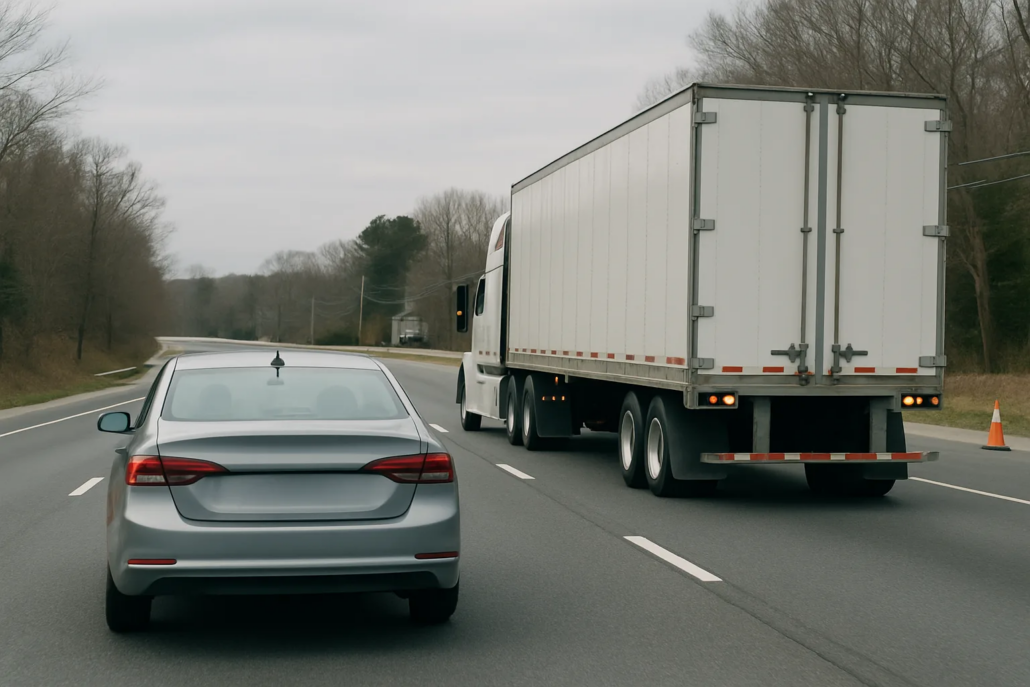
A truck lane change accident lawyer in Annapolis may need to reconstruct a collision from evidence that disappears quickly. A sideswipe can happen in seconds, while the drivers may later disagree about signaling, speed, lane position, or who entered the lane first. If you are evaluating Annapolis truck accident lawyers, understanding what to preserve can help you describe the event more accurately.
Commercial trucks have large blind spots, different mirror coverage, and greater length than passenger vehicles. Some also use side cameras, forward-facing cameras, or electronic systems that may help clarify movement and timing. Murnane & O’Neill provides this guide to documenting a possible unsafe truck lane change in Annapolis, MD, or Arnold, MD. It covers photographs, dashcam files, witness information, roadway conditions, medical records, truck data, and insurance communications.
How an Unsafe Truck Lane Change Can Cause an Annapolis Collision
A truck driver generally needs enough space and visibility to move into another lane safely. A tractor-trailer’s blind spots can make that task more difficult, but limited visibility does not by itself establish who was responsible. Investigators may examine whether the driver checked available mirrors and cameras, used a turn signal, allowed adequate merging space, and accounted for the speed of nearby traffic.
Why lane position and timing matter
In a commercial vehicle merging accident, the order of events may be disputed. One driver may say the truck moved into an occupied lane. The truck driver may report that the car accelerated into a gap after the truck began moving over. Damage patterns, video, witness accounts, and roadway evidence can help test those competing perceptions.
A sideswipe may leave damage along a vehicle’s doors, quarter panel, mirror, or side rail. Those marks can provide useful clues, but photographs alone may not establish fault. Vehicle positions, tire marks, debris, lane markings, traffic flow, and the precise point of contact also matter. In Annapolis, traffic patterns and lane changes near major routes can make a careful scene record especially useful.
What Evidence Supports a Truck Lane Change Accident Claim?
The most useful evidence is often created or preserved soon after the crash. If it is safe to do so, a driver may consider documenting:
- Wide photographs showing the roadway, lanes, traffic controls, and final vehicle positions.
- Close photographs of damage, broken mirrors, paint transfer, debris, and visible tire marks.
- The truck’s identifying information, including its company name, trailer details, and license plate, when safely available.
- Dashcam footage in its original format, along with the device or memory card when appropriate.
- Names and contact information for witnesses, including passengers or nearby motorists.
- The direction of travel, lane of travel, merge point, weather, lighting, and any obstruction affecting visibility.
- The police report, insurance correspondence, repair estimates, medical records, bills, and work-related restrictions.
The Maryland truck accident evidence guide offers a broader framework for preserving these materials. Avoid editing, overwriting, or deleting original video. A copied file may be useful for review, but preserving the original can help address questions about timing or authenticity.
Documenting the roadway and truck data
Return visits to a crash location should be handled carefully and only when safe. Record the exact road and direction, lane configuration, merge area, signs, markings, nearby businesses, lighting, weather, and sight lines. A resource explaining what an Annapolis accident investigation checks at the roadway can help readers understand why roadway context matters even when a crash does not occur in a traditional intersection.
A commercial truck may contain electronic control module information, event data, forward-facing video, side-camera footage, or other records. Availability varies by vehicle and carrier, and systems may retain information for limited periods. The commercial truck black box and camera evidence may help evaluate speed changes, braking, signaling, movement, or visibility conditions. Depending on the circumstances, an attorney may send preservation requests before relevant company or vehicle data is lost.
Medical Records, Insurance Calls, and Potential Responsibility
A sideswipe can cause symptoms that are not obvious at the scene. Some people notice pain, stiffness, headaches, or other concerns later. Appropriate medical evaluation can create a record of reported symptoms and any limitations, while treatment records may help show how the condition developed. The guide on when delayed collision symptoms require medical care discusses the importance of accurate symptom reporting and retaining related records.
Keep copies of visit summaries, bills, prescriptions, work restrictions, and communications about missed work. Do not assume that a minor-looking scrape means there is no need to document physical concerns. Medical decisions belong with qualified healthcare professionals, not an insurance adjuster or a legal article.
Be careful with early insurance communications
A trucking insurer may contact a driver soon after a collision. The caller may ask for a recorded statement, a broad medical authorization, or a quick description of speed and lane position. Memories can be incomplete, especially after a stressful event. A person who guesses may unintentionally create inconsistencies with photographs, video, or later medical records.
Generally speaking, it is prudent to organize known facts before discussing disputed details. Avoid speculation, accusations, or statements about fault that you cannot support. The resource addressing when a Maryland truck insurer requests a recorded statement explains why the timing and scope of an insurance communication can matter. Depending on the circumstances, an attorney may review requests before a recorded statement or release is provided.
The driver may not be the only relevant party
A claim may involve questions about the truck driver’s conduct and the trucking company’s role. Investigators may examine training, supervision, vehicle systems, maintenance, scheduling, dispatch expectations, and whether company records were preserved. That does not mean a carrier is automatically responsible. The facts and applicable Maryland law determine which parties, if any, may have legal responsibility.
The discussion of driver and trucking company liability in a commercial crash explains why a review may extend beyond the person behind the wheel. In Annapolis, Arnold, and elsewhere in Anne Arundel County, preserving evidence early can help an attorney evaluate the full picture rather than relying only on conflicting statements.
Common Documentation Mistakes After a Truck Merge Collision
A person does not need to become an accident investigator at the scene. Still, several avoidable mistakes can make later review more difficult:
- Failing to save original video. Dashcam systems may overwrite older files. Preserve the source file and note when it was created.
- Photographing only vehicle damage. Close-ups are useful, but wide roadway images can show lane geometry, visibility, and traffic controls.
- Assuming the police report resolves every dispute. A report may record initial statements, but additional evidence can provide important context.
- Guessing about speed or lane position. It is acceptable to say that you do not know. Accuracy is more useful than certainty based on memory.
- Ignoring later symptoms or records. Keep medical and employment documentation organized, and describe concerns accurately to healthcare providers.
- Posting about the crash online. Public statements or photographs may be viewed without the surrounding context.
Maryland deadlines and procedures can affect an injury claim, and they may depend on the parties, facts, and type of claim involved. Laws can vary by location and may change after publication. A licensed Maryland attorney can assess how those rules may apply to a particular collision.
Frequently Asked Questions
What if the truck driver says I entered the lane first?
Conflicting accounts do not automatically resolve responsibility for a commercial lane-change collision. Investigators may compare vehicle damage, dashcam footage, witness observations, roadway geometry, traffic timing, and available truck data. The police report may be one source of information, but it may not contain every relevant detail. An attorney can review the available evidence and explain what additional information may help evaluate the competing accounts.
Can a truck’s blind spot excuse a sideswipe crash?
A blind spot may explain why a driver claims not to have seen another vehicle, but it does not automatically determine legal responsibility. The review may consider mirror coverage, camera systems, signaling, speed differences, lane position, and the amount of space available to merge. The effect of those facts depends on the circumstances and applicable Maryland law. A truck blind spot crash claim usually requires a fact-specific analysis rather than a single assumption.
Should I give the trucking insurer my recorded statement?
A driver may receive an early request for a recorded statement, but the driver does not have to guess about disputed facts. Before responding, it may be helpful to understand what information is being requested and whether a broad release or authorization is included. Depending on the circumstances, an attorney can explain potential concerns and help organize accurate information without promising a particular claim outcome.
Does damage to my car prove the truck changed lanes?
Damage may provide clues about the angle and location of contact, but it may not prove the entire sequence by itself. Investigators may also review paint transfer, broken parts, tire marks, debris, photographs, video, witness accounts, and roadway layout. Repair estimates and inspection photographs should be retained. Whether the evidence supports a lane-change theory depends on the complete record and the facts developed in the investigation.
How Murnane & O’Neill Can Help
Murnane & O’Neill is dedicated to helping people understand the evidence and legal issues that may follow a commercial truck collision. The firm can evaluate photographs, dashcam footage, witness information, roadway conditions, medical documentation, insurance communications, and questions involving a trucking company. Its team is committed to fighting for clients’ rights while recognizing that every collision depends on its own facts and applicable Maryland law.
If you were involved in a truck sideswipe or merging collision in Annapolis, Arnold, or nearby Anne Arundel County, contact Murnane & O’Neill for a free consultation or case evaluation. The firm is ready to evaluate your situation and discuss your legal options.
The information in this article is for educational purposes only and does not constitute legal advice. Contact a qualified attorney licensed in Annapolis, MD; Arnold, MD for advice specific to your situation.





Leave a Reply
Want to join the discussion?Feel free to contribute!