Could Police Records Outweigh a Truck Citation in Maryland?
A truck driver receives a citation after a collision on an Annapolis-area road. Does that ticket establish who must pay for the injured person’s medical care, lost income, and other losses? Usually, the answer is more nuanced. A citation may support a negligence argument, but it is only one item in a larger investigation.
For someone researching a truck citation personal injury claim in Maryland, the distinction matters. A traffic officer’s decision at the scene is not the same as a civil court’s evaluation of liability and damages. A citation may be based on what the officer could observe, while a civil claim may require a broader review of photographs, witnesses, medical records, vehicle data, and trucking-company documents. The Maryland truck accident evidence guide provides additional context on preserving that broader proof.
Murnane & O’Neill helps injured readers understand how these pieces may fit together. This article explains what a citation can show, what it cannot establish, which records may be important in Annapolis and Arnold, and why the absence of a ticket does not automatically end an injury claim.
Can a Truck Citation Decide a Maryland Personal Injury Claim?
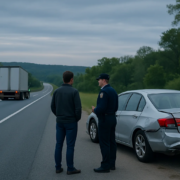
A citation can be relevant, but it generally does not decide a civil injury claim by itself. The ticket may identify an alleged traffic violation, such as an unsafe movement, speeding, or failure to obey a traffic control device. It can help establish what an investigating officer believed happened at the scene.
However, a citation is not necessarily a final finding that the driver caused every injury claimed. The traffic case and the civil case have different purposes, participants, standards, and evidence. A citation may be contested, dismissed, resolved without a trial, or based on incomplete information. Likewise, an officer may issue no ticket even when other evidence supports a negligence claim.
What can police and court records show?
Depending on the circumstances, an injured person may seek or preserve:
- The crash report and any supplemental reports;
- The citation, warning, charging document, or disposition;
- Diagrams, photographs, measurements, and recorded statements;
- Witness names and contact information; and
- Available records from the traffic proceeding.
In Annapolis, a traffic matter may involve a Maryland law-enforcement agency and the District Court of Maryland in Anne Arundel County. The location and availability of records can vary. A lawyer may help identify which records exist and how they may be used in a separate civil claim.
Why the citation is only one piece of proof
A ticket may support an argument about breach of a duty, but a civil claim also commonly requires evidence connecting the conduct to the collision and the claimed injuries. The broader record may reveal facts that the citation does not address, including following distance, visibility, cargo movement, mechanical condition, or whether another vehicle contributed to the crash.
What Evidence Should Be Compared With the Truck Driver’s Citation?
The most useful question is often not whether a citation was issued, but whether the available evidence tells a consistent story. In an Annapolis or Arnold crash, photographs may show vehicle positions, lane markings, debris, lighting, roadway conditions, and damage patterns. Independent witnesses may describe speed, movement, signals, or what occurred immediately before impact.
Inspection violations and mechanical evidence
A citation directed at the driver may not address a defective brake system, worn tire, lighting problem, steering issue, or trailer condition. Inspection, repair, and maintenance records may help determine whether a mechanical issue existed and whether it contributed to the collision. Review truck maintenance records that may clarify a Maryland crash for more information about this type of evidence.
An inspection violation does not automatically establish liability. Its significance depends on the condition involved, the timing, causation, and the evidence tying it to the crash. Records may also show whether a problem was reported, repaired, or overlooked before the vehicle traveled through Anne Arundel County.
Vehicle data that can test the account
Commercial trucks may contain electronic control modules, event data, onboard camera systems, GPS information, or other records. Depending on the vehicle and system, this evidence may help evaluate speed, braking, steering, timing, or driver activity. It may confirm an account, reveal uncertainty, or raise questions that a citation does not answer. Commercial truck black box evidence in Anne Arundel County explains why prompt preservation can matter.
Medical records and proof of harm
The citation typically addresses conduct, not the full extent of an injured person’s losses. Medical records, diagnostic results, treatment notes, bills, and documented limitations may help establish the injury portion of a claim. Information about handling medical bills after an Annapolis-area injury accident may help readers understand why organized medical documentation is important.
How Do Civil Claims Differ From Traffic and Criminal Proceedings?
A traffic or criminal proceeding focuses on whether the government can establish a charged offense. A civil injury claim asks different questions: whether a person or entity acted negligently, whether that conduct caused harm, and what losses may be legally recoverable. The result of one proceeding may be relevant, but it does not necessarily resolve every issue in the other.
Why no ticket does not automatically defeat a claim
An officer may not witness the collision, may lack enough information to issue a citation, or may focus on a different violation. An injured person may still have photographs, testimony, vehicle evidence, medical documentation, or other proof. In some situations, a claim may be evaluated even when there is no police report; see building a Maryland injury claim without a police report for related considerations.
When the citation misses the underlying safety issue
A citation for an observable traffic maneuver may not reveal fatigue, scheduling pressure, or hours-of-service concerns. Records such as electronic logs, dispatch information, trip schedules, and employment records may be relevant when fatigue is part of the investigation. Evidence of fatigue should be evaluated carefully rather than assumed from the fact that a long trip occurred. Resources on proving fatigue through Maryland truck-driver records discuss why records may matter.
Why the driver may not be the only party considered
A driver’s citation identifies an alleged action by the driver. It may not answer whether a carrier, employer, maintenance provider, or another trucking entity had a separate role. Depending on the facts, investigation may examine hiring, supervision, dispatching, maintenance, ownership, or company policies. Read about when Maryland trucking company liability reaches the carrier for a broader explanation.
Readers should also be cautious about discussing fault with an insurer before understanding the evidence. Statements made soon after a collision may omit important facts, especially when the person is dealing with pain, stress, or incomplete information. Generally speaking, preserving records and obtaining advice about the applicable Maryland process can help clarify what evidence is available.
Frequently Asked Questions
Does a truck driver’s ticket prove negligence in Maryland?
Not automatically. A ticket may support an argument that the driver violated a traffic rule, but a civil claim still typically requires evidence of causation and legally recognized harm. The citation’s wording, disposition, issuing officer’s observations, and relationship to the collision may all matter. Other evidence, including photographs, witnesses, vehicle data, and medical records, can support or contradict the conclusions suggested by the ticket.
Can I pursue a claim if the truck driver received only a warning?
A warning does not necessarily prevent an injury claim. Officers may issue warnings, decline to cite a driver, or lack enough information to determine the complete cause of a crash. A civil claim may rely on independent evidence about roadway movement, vehicle condition, witness observations, and injuries. The strength of that evidence depends on the facts and the applicable Maryland law.
Where can I obtain records from an Anne Arundel truck crash?
Potential sources may include the investigating law-enforcement agency, the District Court of Maryland when a case was filed there, insurers, medical providers, witnesses, and the trucking company or its representatives. Access rules and available records vary. An attorney may help identify appropriate requests and consider whether additional preservation steps are needed for vehicle data or business records.
Does a dismissed citation mean the civil case is over?
No. A dismissed, reduced, or otherwise resolved citation does not necessarily determine whether a separate civil injury claim can proceed. The traffic matter may involve different evidence and legal questions from the civil case. The effect of the disposition depends on the circumstances, the available proof, and Maryland procedure. A qualified attorney can explain how the specific record may affect an individual claim.
How Murnane & O’Neill Can Help
Murnane & O’Neill is dedicated to helping injured people understand the evidence surrounding truck and car collisions in Annapolis, Arnold, and throughout Maryland. The firm can evaluate how police records, citations, warnings, inspection information, electronic vehicle data, witness accounts, medical documentation, and potential carrier involvement fit together.
The team is committed to fighting for clients’ rights while presenting a careful, fact-based assessment of available legal options. Contact Murnane & O’Neill for a free consultation or case evaluation to discuss your situation.
The information in this article is for educational purposes only and does not constitute legal advice. Contact a qualified attorney licensed in Annapolis, MD; Arnold, MD for advice specific to your situation.